
Intra-Company Transfer Canada • C11 Significant Benefit Work Permit • Buy a Business Work Permit
Intra-Company Transfer Canada explained in simple terms. Learn how C11 Significant Benefit, ICT codes C61–C63, and buying a business can or cannot lead to a work permit in 2025
IMMIGRATION TIPS & STEP-BY-STEP GUIDESBUSINESS IMMIGRATION
Mehdi Nafisi
12/5/20253 min read
Intra-Company Transfers, Buying a Business, and Canada’s New Work Permit Codes: What You Need to Know
If you’ve been thinking about coming to Canada as a business owner or investor, you’ve probably heard a lot of mixed information.
Some people say, “Just buy a business and you’ll get a work permit.”
Others talk about “ICT,” “C12,” or “specialized knowledge.”
The truth is more nuanced. Canada does offer options for entrepreneurs and companies that want to expand here, but the rules are specific, and the government is watching these programs more closely than ever.
In this article, I’ll explain everything in a simple, straightforward way.
C12 Is Gone — Here Are the New Codes
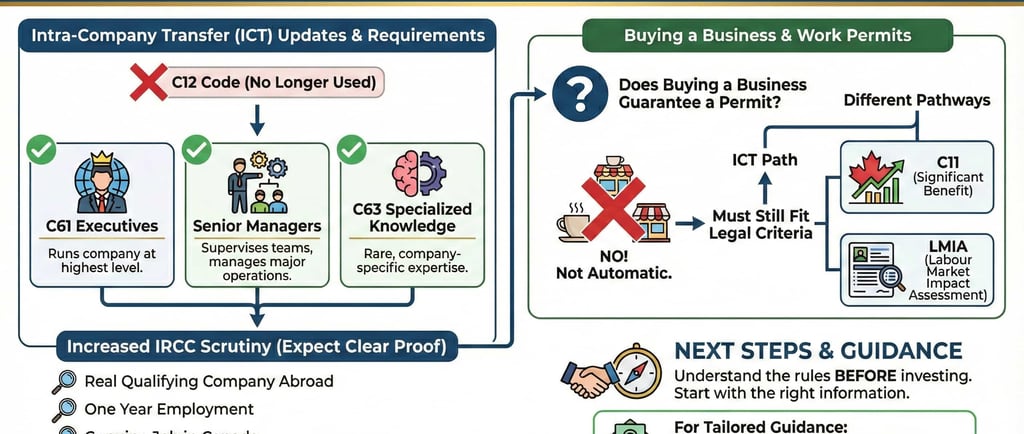
For years, intra-company transfers were grouped under a single code called C12. IRCC has now retired that code and replaced it with three new ones:
• C61 for Executives
• C62 for Senior Managers
• C63 for Specialized Knowledge Workers
These fall under IRPR 205(a), which allows certain workers to get a Canadian work permit without an LMIA because they can bring “significant benefit” to Canada.
Here’s the quick version of each one:
C61 – Executives
People who run the business at the highest level.
Example: a CEO or country director coming to set up Canadian operations.
C62 – Senior Managers
People who manage teams, budgets, or departments.
Example: an Operations Manager overseeing daily business activities.
C63 – Specialized Knowledge Workers
People with rare, company-specific expertise.
Example: someone who built a proprietary system and is needed to implement it in Canada.
C63 is tightly scrutinized. Officers look closely at whether the knowledge is actually unique and whether the salary matches the skill level.
Does Buying a Business Give You a Work Permit?
A lot of people are surprised when they learn this:
Buying a business — even a successful one — does not automatically make you eligible for a work permit.
If someone purchases a coffee shop, restaurant, bakery, salon, or retail store, they do not automatically qualify under ICT.
To qualify under ICT, you must:
• Already own or work for a company outside Canada
• Have at least one full year of full-time employment with that foreign company
• Create a qualifying relationship between your foreign company and the Canadian business
• Have a role in Canada that fits C61, C62, or C63
If you don’t meet these, ICT is not the right path.
What About C11? Has That Changed?
C11 is the “significant benefit” work permit for entrepreneurs and self-employed people who want to run a business in Canada.
The law hasn’t changed, but the way officers assess it definitely has.
Officers now expect much stronger evidence, including:
• Real job creation
• Demonstrated economic or cultural benefit
• A credible financial investment
• Relevant experience to run the business
• A realistic business plan and operational capacity
If you buy a small service business or a low-impact retail shop, it’s much harder to meet today’s threshold. Officers are applying stricter criteria and approving fewer borderline cases.
Your understanding is accurate: C11 approvals now lean toward qualified entrepreneurs with stronger business profiles.
If ICT and C11 Don’t Fit, What Else Exists?
There are still other routes:
• LMIA (owner–operator style)
• Provincial entrepreneur programs
• Investor categories under trade agreements like CUSMA, CETA, CPTPP
• Start-Up Visa for innovative companies
Each pathway has its own requirements and risks, and none of them guarantee approval just because someone invests money.
Common Questions
“If I buy a business, do I get a work permit?”
No. You must still qualify under a specific program.
“Can I open a branch of my foreign company in Canada?”
Yes, and ICT may work if the structure and your role match C61, C62, or C63.
“Is C11 still an option?”
Yes, but the standard is higher than before.
“Can ICT lead to PR?”
For some people, yes, through Express Entry or PNP programs.
Final Thoughts
Canada welcomes entrepreneurs and global companies, but the programs are not “automatic pathways.” The government expects strong evidence, credible business activity, and real benefit to Canada.
Understanding the differences between C61, C62, C63, C11, LMIA, and provincial programs is essential before making any investment decisions.
If you want professional guidance tailored to your situation,
© 2025. All rights reserved.
Strategic. Human. Results-driven. Complete Canadian immigration services for visas, PR, and complex cases. We go beyond paperwork.
Menu


Legal Notices
Resources